What you can change in Playground, and why the limits exist
Every slider has a floor and a ceiling. They are not there to frustrate you, they are the difference between a part that prints and a puddle of plastic.
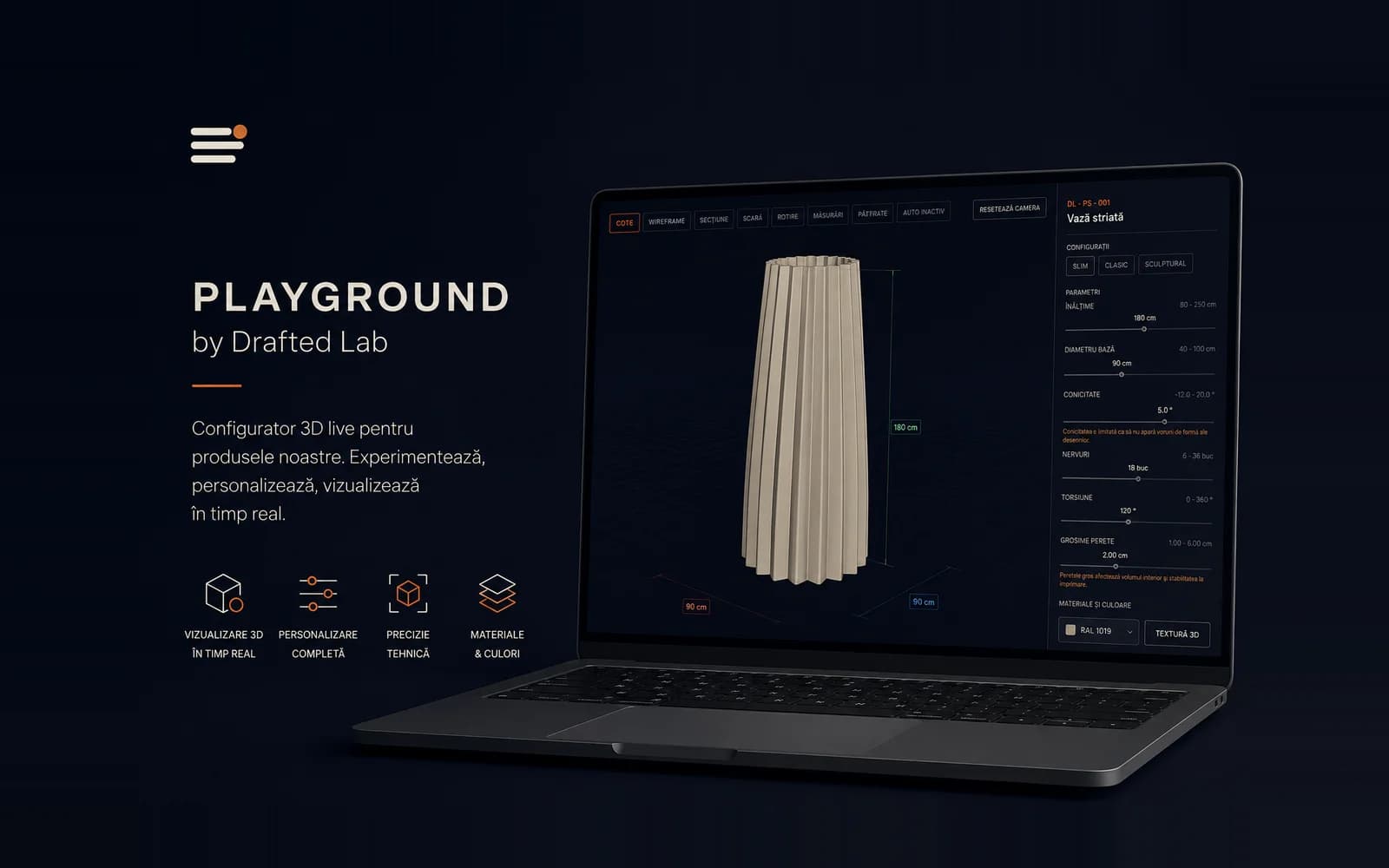
Playground starts you with a handful of real objects rather than a blank canvas: a vase, a headset hook, a phone stand, a dice tower, a VESA adapter. Each one has its own set of dimensions you can move, and each slider stops somewhere.
The limits are physics, not policy
The bed. A printer has a build volume, and nothing larger than it exists as far as the machine is concerned. When a slider stops, it is usually because the next millimetre would put a corner of your object outside the box.
Wall thickness. Below a certain thickness a wall is not a wall, it is a suggestion. The nozzle lays a line of a fixed width, so a wall thinner than a couple of those lines comes out fragile or full of gaps. The minimum in the configurator is the point where the piece still holds together in your hand.
Overhangs. Plastic leaving the nozzle needs something under it. Past roughly forty five degrees it starts to droop, which is why some shapes need supports and some proportions are simply not offered. When a slider will not go further, it is often protecting you from a surface that would print as a mess.
What actually changes when you move something
The whole object rebuilds. It is not a picture being stretched: the geometry is generated again from your numbers, and everything that depends on those numbers is recalculated with it. That is why the weight, the print time and the price all move together instead of updating a beat later.
Engraving
Some models take a short text. It is worth knowing that engraved letters add print time, so the price moves when you type. Keep it short and it stays legible: at small sizes, letters cut too fine disappear into the layers.
A configurator that let you build anything would mostly let you build things that fail. The interesting freedom is the one that ends with a piece in your hand.
If the shape you want is not there
The parametric models are a starting point, not the catalogue of what we can make. For anything outside them, the custom form is still the way: a photo, a sketch, a measurement, and we will tell you what it takes.
PLAYGROUNDDESIGNGUIDE